
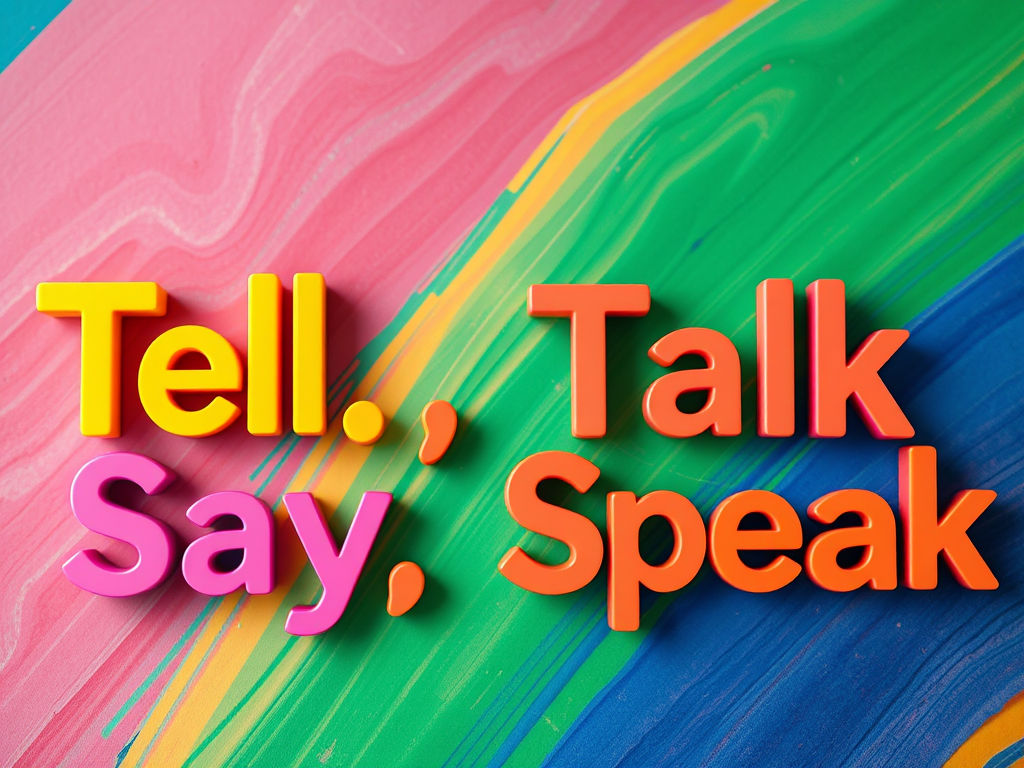
Trying to explain why you “said a lie” instead of “told a lie”? Or wondering if it’s “speak with friends” or “talk to friends”?
These four verbs—tell, say, speak, talk—are notorious for tripping up English learners. But don’t worry! This guide will break down their differences with simple rules, hilarious examples, and tricks to never mix them up again.
1. Say vs. Tell: The Basics
Say (said, said)
- Use it for: General statements, quoting someone, or indirect speech.
- No need for a listener’s name!
✅ Correct Examples:
- She said, “I’m tired.” (Direct quote.)
- He said (that) he was hungry. (Indirect speech.)
❌ Common Mistake:
- “She said me hello.” → SAY doesn’t take a direct object.
Tell (told, told)
- Use it for: Giving information, instructions, or stories to someone specific.
- Always needs a listener!
✅ Correct Examples:
- She told me a secret. (Who? Me!)
- Can you tell the kids a story? (Who? The kids!)
❌ Common Mistake:
- “He told that he was late.” → Missing the listener!
→ Fix: He told me (that) he was late.
💡 Memory Hack:
- Tell = Transfer information to someone.
- Say = Share information generally.
- “Tell someone, say something“
2. Speak vs. Talk: The Nuances
Speak (spoke, spoken)
- Use it for:
- Formal communication (speeches, presentations).
- Languages (“She speaks Spanish”).
- One-way communication (e.g., “The teacher spoke to the class”).
✅ Correct Examples:
- I need to speak to your manager. (Formal tone.)
- Do you speak French?
Talk (talked, talked)
- Use it for:
- Casual conversations (chatting with friends).
- Two-way discussions (“Let’s talk about it”).
✅ Correct Examples:
- We talked for hours. (Informal.)
- They’re talking on the phone.
💡 Memory Hack:
- Speak = Serious or Solo (like a speech).
- Talk = Together (like a chat).
3. Common Mix-Ups (Fixed!)
Mistake #1: “I want to say you something.”
→ Fix: “I want to tell you something.”
(“Tell” needs a listener!)
Mistake #2: “Can you talk Spanish?”
→ Fix: “Can you speak Spanish?”
(Use “speak” for languages.)
Mistake #3: “She spoke about her vacation.”
→ Technically correct, but “She talked about her vacation” sounds more natural (casual convo).
4. Phrasal Verbs to Level Up
- Speak up = Talk louder.
→ “Can you speak up? I can’t hear you!” - Talk over = Interrupt.
→ “Stop talking over me!” - Tell off = Scold someone.
→ “My boss told me off for being late.”
5. Quick Quiz (Test Yourself!)
- “She ___ (say/tell) goodbye and left.”
- “Can I ___ (speak/talk) to you privately?”
- “He ___ (said/told) us a funny joke.”
Answers:
- said (no listener needed).
- speak (formal/private convo).
- told (listener = us).
6. Pro Tip: Practice with Dialogues!
Watch a movie scene and write down:
- How characters use say/tell vs. speak/talk.
- Example from Friends:
Phoebe: “He told me he loves you!”
Rachel: “What? Why didn’t you say something sooner?!”
💬 Still confused? Ask me in the comments! Let’s talk about it. 😉

 Read, Write, English!
Leave a comment